
At Mondeo, quality is a journey that spans the entire production process. With over 40 years of experience, we have developed an internal testing procedure where every single valve is tested with calibrated procedures according to the specific characteristics of the product. Not a sample test, but a codified system that involves our entire production.
For check valves, the most significant test is the seal/leak test. If sealing is not perfect, the very function of the valve is compromised and, consequently, the efficiency of the entire system, causing pressure losses or critical phenomena such as water hammer.
In the specific case of check valves up to 2”, we have translated the quality control concept into a true 200% test: each valve is subjected to two distinct seal test phases before leaving the factory.
Pre-assembly leak testing
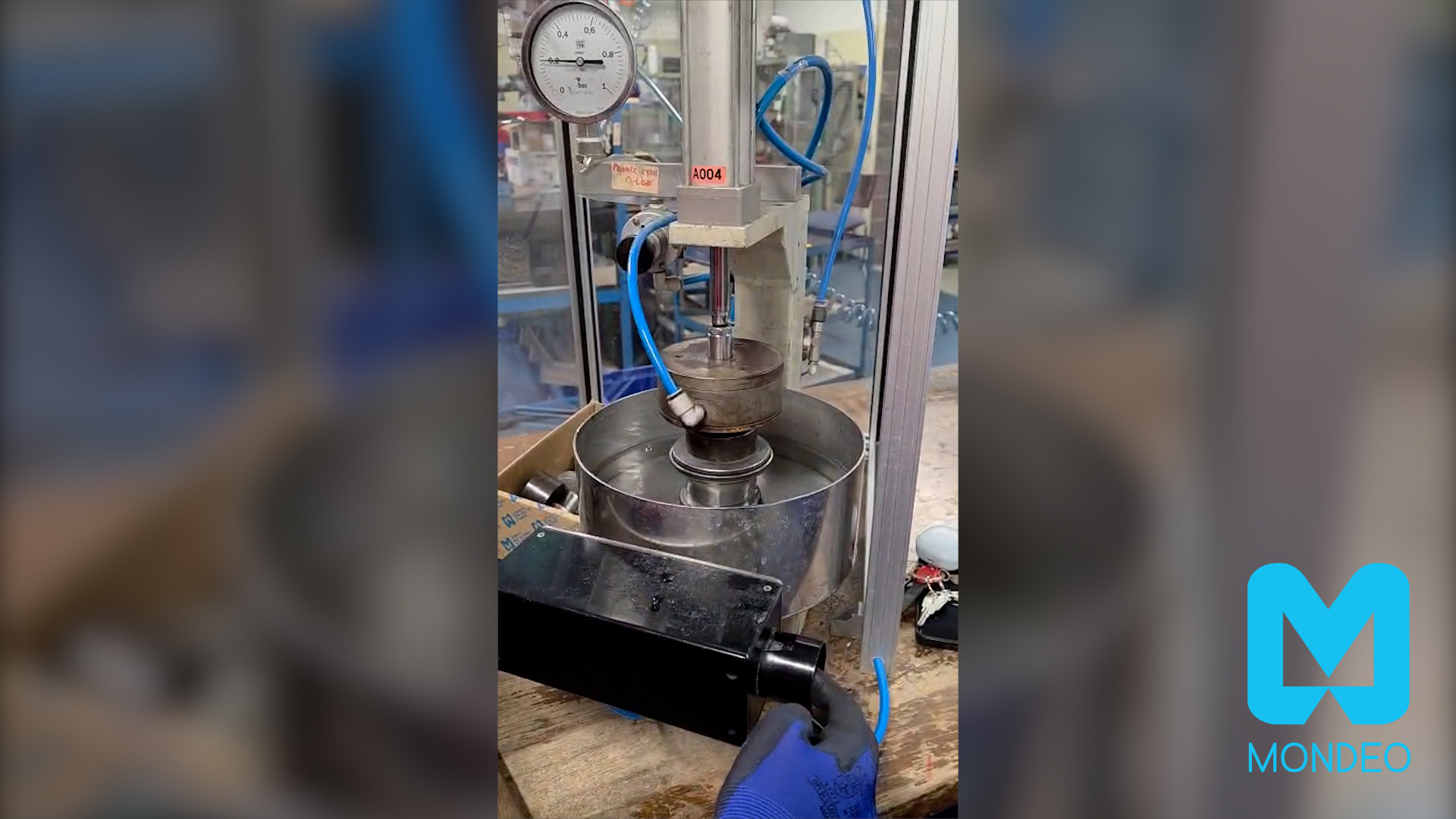
The first step to verify the tight seal of the internal gasket takes place during the pre-assembly phase. The lower part of the valve is submerged in water up to half of the sleeve. Compressed air is injected to operate the shutter, simulating actual operational conditions for at least 20 seconds. The presence of any air bubbles in the water indicates an imperfect seal and allows any anomaly to be intercepted immediately. For NBR, EPDM, and FPM seals, a pressure of 0.2 bar is used; for FEP and PTFE seals, the pressure is 0.5 bar.
Post-welding testing
Once the lower and upper parts have been assembled by welding, the valve undergoes a second seal test. Why repeat the test? Because the high heat generated by the welding process could alter or damage the internal seal. The test is performed using the same methodology: the valve is submerged in water and compressed air is injected at 0.2 or 0.5 bar depending on the type of seal, always maintaining the pressure for about 20 seconds. This protocol ensures that the valve works perfectly from the very early stages of system startup, preventing downtime and post-installation maintenance work.
Our focus on testing goes hand in hand with the constant evolution of component parts:
Optimized profile: continuous refinement of geometries, angles, and edges ensures a perfect fit with the valve structure, extending durability and boosting efficiency.
Supplier selection: valves are fitted with different seals depending on the applications, and in all cases we guarantee top quality raw materials.
Custom design: we do not use standard off-the-shelf seals, but solutions crafted to the specific design of the valve.
FAQ
Why is it important to use a pneumatic test for check valves instead of relying on gravity water filling?
Simply filling the valve with water as if it were a glass would only confirm whether it is correctly assembled, if the seal is completely missing, or if there are macro-holes, but it would not be an effective test to reveal small defects. Due to its surface tension, water cannot pass through micro-scratches or minimal geometric imperfections. Compressed air, on the other hand, consists of much smaller and more penetrating molecules: if there is even the slightest leakage, the pneumatic test detects it instantly.
Why is the seal test performed at low pressure?
If we used high pressure, the force of the fluid would press the shutter against the seat, temporarily deforming the seal and masking potential defects. Once installed on the actual system, however, the valve could leak at minimal operating conditions. If the valve guarantees an airtight seal at low pressure, it means the geometric coupling is perfect and will hold without issues.
Why is a slightly higher pressure used for PTFE and FEP seals?
At 0.2 bar, the air thrust would not have sufficient mechanical force to overcome the rigidity of PTFE and bring the two rigid surfaces (shutter and seat) into perfect alignment. By raising the pressure to 0.5 bar, the air receives the necessary force to generate the minimum load required to match the surfaces. The pressure nevertheless remains low enough and the test sensitive enough to spot minimal defects.