
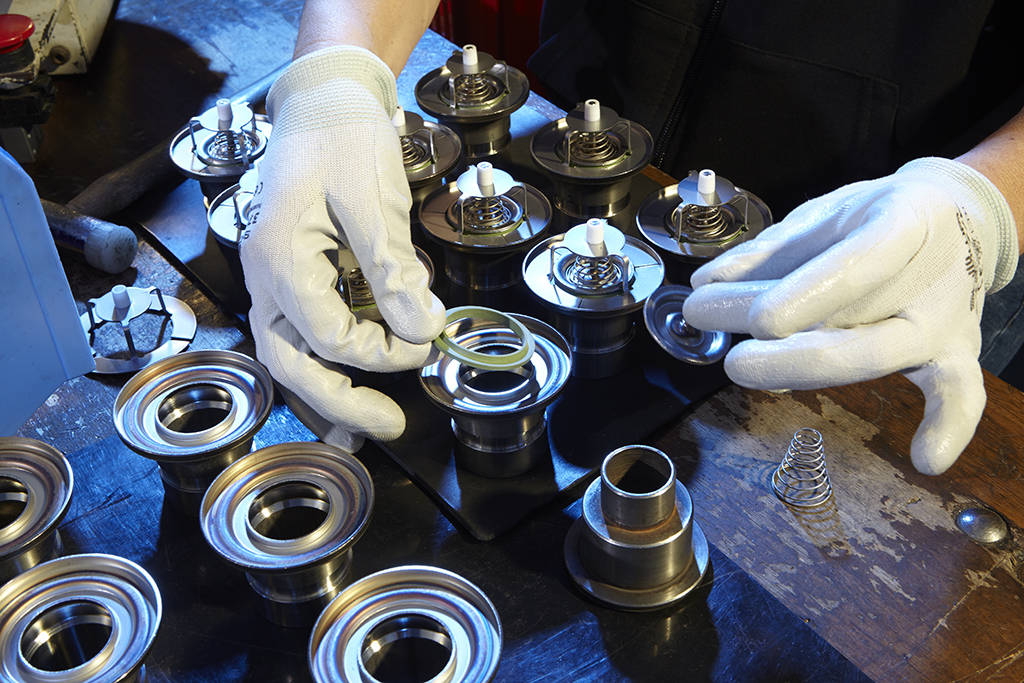
The leakage rate is the parameter used to indicate how well a hydraulic valve seals. The UNI EN 12266-1 standard identifies seven rates, from A to G, which refer to the maximum permitted leakage through the sealing seat according to the nominal diameter of the valve.
Mondeo’s Idrja and Small check valves with rubber gasket (NBR, EPDM and FPM), are rate A, while the company guarantees that its Idrja and Small check valves with PTFE gasket are rate B at room temperature. Valves with gaskets made from PTFE, which is more rigid than rubber, are required when solvents are being used. The leakage rate of our PTFE gaskets, just like that of our rubber gaskets, is extremely low.
How Mondeo check valves guarantee zero leakage
The sealing efficiency of our check valves comes from certain characteristics, for example how they are processed, the study and choice of materials, but more specifically:
- accurate and uniform metal component processing;
- stainless steel sheets used as the base component, which guarantees less surface roughness and, as a result, better valve sealing;
- top quality gaskets, the result of careful study that led to the development of an exclusive design which guarantees better sealing over time;
- quality controls carried out on 100% of the valves that are produced.
The UNI EN 12266-1 Standard applied to our check valves
The leakage test is done by putting the shutter of the valve, which is vertical and fully closed, under a specific differential pressure.
We apply a closing counter-pressure of 0.2 bar to our check valves because it reflects the limit operation situation of most of the systems in which the valves are inserted. Even though system counter-pressures are rarely lower, Mondeo can still offer customised solutions if they are.
Every valve we produce is tested for leakage
We test all our valves for leakage before they are placed on the market. As testing is an important part of our production process, we have implemented a new technological solution for testing that is even more effective. It is a system we designed specifically to make testing our valves as reliable as possible. This new instrument, which uses electronic sensors, can even identify microleaks and test both the gasket and the welding.